
System design goals focus on building software systems that are scalable, reliable, efficient, and user-friendly, while meeting both functional and non-functional requirements. In practice, this means balancing trade-offs between performance, cost, usability, and adaptability to future needs.
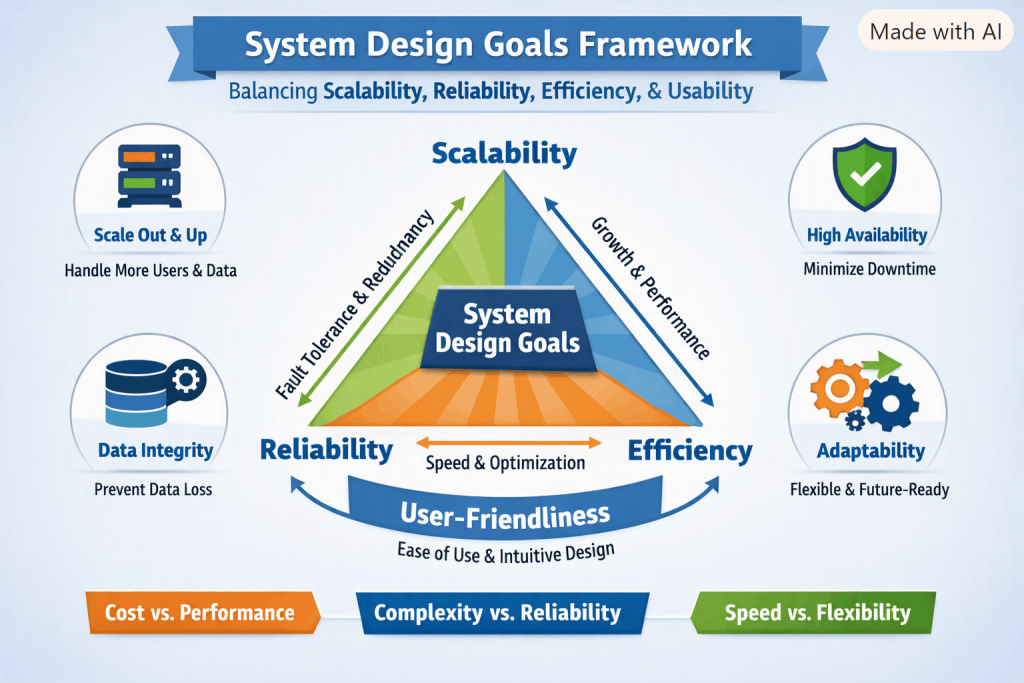
Key Goals of System Design
1. Scalability
- Ability to handle increasing traffic or data by adding resources.
- Supports both vertical scaling (upgrading hardware) and horizontal scaling (adding more servers).
- Example: A social media platform must scale to millions of users without crashing.
2. Reliability
- Ensures the system continues to function correctly even during failures.
- Includes fault tolerance, redundancy, and failover mechanisms.
- Example: Payment gateways must process transactions reliably without losing data.
3. Efficiency
- Optimizes resource usage (CPU, memory, bandwidth).
- Targets low latency (fast response times) and high throughput (handling many requests per second).
- Example: Search engines must return results in milliseconds.
4. User-Friendliness
- Systems should be intuitive and easy to use.
- Clear interfaces and smooth workflows reduce user frustration.
- Example: E-commerce sites must make checkout simple and fast.
5. Accuracy & Completeness
- Must fulfill functional requirements (what the system does) and non-functional requirements (performance, security, usability).
- Example: A banking app must calculate balances correctly and also ensure secure access.
6. Optimization
- Focuses on time and space efficiency for algorithms and data structures.
- Example: Using indexing in databases to speed up lookups.
7. Flexibility & Adaptability
- Systems should evolve with changing user needs or business requirements.
- Example: Cloud-native apps can adapt to new workloads easily.
Comparison Table of System Design Goals
| Goal | Focus Area | Example Use Case |
|---|---|---|
| Scalability | Handle growth in traffic/data | Instagram feed scaling |
| Reliability | Fault tolerance, uptime | Payment gateway |
| Efficiency | Resource optimization, speed | Google search |
| User-Friendliness | Ease of use, intuitive UI | Amazon checkout |
| Accuracy | Correctness of outputs | Banking app |
| Optimization | Time/space efficiency | Database indexing |
| Flexibility | Adaptability to change | Cloud-native apps |
Trade-Offs & Challenges
- Scalability vs. Cost: Adding servers improves performance but increases expenses.
- Reliability vs. Complexity: More redundancy means more complex architecture.
- Efficiency vs. Flexibility: Highly optimized systems may be harder to adapt later.
- Consistency vs. Availability: CAP theorem forces trade-offs in distributed systems.
In short, system design goals are about balancing scalability, reliability, efficiency, usability, and adaptability.